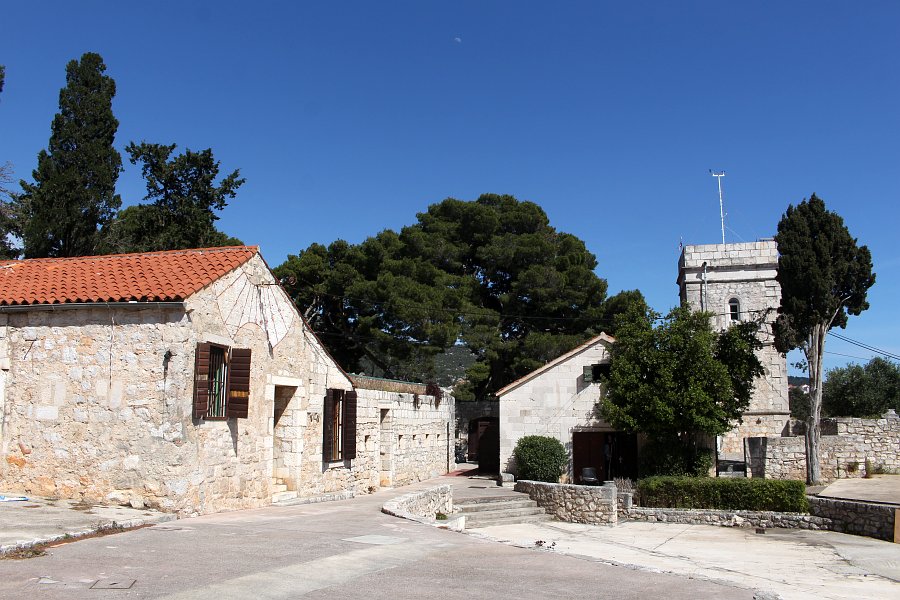
Vertical sundial on the southern facade of the building inside the Veneranda, a former hospice and fortress. On the stone near the sundial is carved "Aug. 1950 F.J." which can be the date of creation and the author's signature.
Hospice and church of St. Veneranda was built by the Venetian authorities in 1561 for the needs of Greek Catholic sailors in the service of the Republic of Venice. It consisted of a church with a bell tower on the eastern edge of the complex and houses along the northern edge. The Catholic altar of St. Francis was added to the church in 1685. During the attack of the Russian army on Hvar in 1807, the monastery and the church were damaged. In 1811, the Napoleonic administration demolished the bell tower, built cannon positions to the south, and fortified the complex with a wall with loopholes. In the middle of the 19th century, the complex was sold to the famous naturalist Grgur Bačić, who founded one of the first meteorological stations in Croatia in 1858. A summer stage was arranged inside the complex in 1952, when numerous spolia of the original monastery were incorporated into the modern structure.
References: